Managing a Linux-based IT infrastructure requires specialized technical expertise. Businesses must ensure system reliability, strengthen server security, and keep critical business applications available.
Linux server management allows businesses and organizations to outsource server administration, maintenance, and monitoring to a specialized IT service provider.
Outsourcing helps address several key challenges: strengthening IT infrastructure security, identifying potential server issues, and supporting business continuity. However, effective outsourcing requires a thorough understanding of the IT environment and a clear division of responsibilities.
What Does Linux Server Management Include?
Linux server management covers the system administration, IT maintenance, and infrastructure monitoring activities needed to keep servers running reliably.
These services may involve physical servers, virtual servers, or infrastructure spread across multiple environments. The scope of support depends on the applications being hosted, IT security requirements, and each organization's availability needs.

Linux System Administration and Server Maintenance
Linux server administration involves installing, configuring, maintaining, and upgrading the operating system and its associated software services.
Key tasks include managing users and access permissions, applying system updates, configuring network services, and managing computing resources.
For Linux distributions such as Debian and Ubuntu, these tasks require extensive knowledge of the operating system, software dependencies, and running services.
In addition, Linux server maintenance must account for hosted applications to minimize compatibility issues and service disruptions during maintenance.
These environments may include web servers, databases, email services, and business applications. Managing them effectively requires a solid understanding of how Linux interacts with installed software.
Expertise in the installation, configuration, and maintenance of server applications helps ensure that all components of the IT infrastructure work together reliably.
IT Security, Backups, and Server Monitoring
Securing a Linux infrastructure involves several complementary measures, including protecting administrator access, applying security patches, reviewing system configurations, and monitoring security events.
In addition, a well-designed data backup strategy helps protect hosted information and applications. It should include recovery procedures suited to operational requirements, along with regular testing to ensure backups can be restored successfully.
We generally implement two levels of backup. The first backs up the virtualized system to enable rapid recovery. The second uses individual file and database backups to support atomic data restoration.
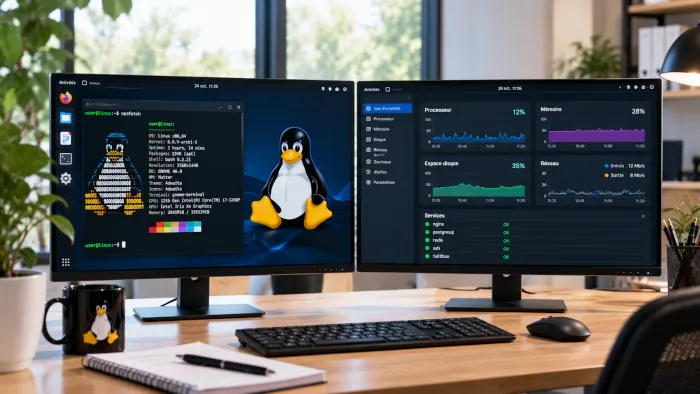
Meanwhile, Linux server monitoring tracks CPU usage, memory consumption, disk space, and the status of essential services. This ongoing monitoring helps detect technical issues and identify early warning signs of system failures.
Combined with preventive IT maintenance, these practices help improve infrastructure reliability and reduce the risk of service downtime.

Why Outsource Linux Server Administration?
Outsourcing Linux server administration gives businesses access to specialized technical expertise without having to maintain every required skill in-house.
This approach offers several benefits, especially when servers host critical applications or services essential to daily business operations.
Gain Access to Specialized Linux System Administration Expertise
Linux server administration goes well beyond the initial setup. It requires in-depth knowledge of system configurations, network services, security mechanisms, and application dependencies.
Moreover, business IT environments often combine several technologies, including server virtualization, databases, web services, email systems, and business software.
Working with a provider specializing in Linux server management gives businesses access to the technical expertise needed to maintain these environments and support their ongoing development.
We continually update our skills to keep pace with changes in technology and IT infrastructure.
This expertise becomes particularly valuable when a business needs to upgrade its IT infrastructure, introduce new services, or resolve complex system administration issues.
Reduce the Risk of Server Failures and Downtime
Hardware failures, system configuration errors, and service outages can disrupt a company's IT operations.
That's why preventive server maintenance and regular Linux system monitoring are essential to infrastructure reliability.
Reviewing system logs, monitoring resource usage, and carefully managing updates can help identify issues before they affect business applications or users.
When problems occur, a clearly defined IT incident management process makes it easier to diagnose the issue, identify its root cause, and implement corrective actions.
However, managed IT services cannot eliminate every risk of failure. Instead, they help businesses manage these risks through structured maintenance, appropriate monitoring, and well-defined response procedures.
Make Better Use of Internal IT Resources and Expertise
Outsourcing Linux server maintenance allows internal IT teams to spend more time on software development projects, improving business applications, and enhancing services for end users.
Routine system administration, maintenance, and monitoring require specialized technical skills and sufficient availability to meet operational demands.
Outsourced management can therefore complement internal IT resources. This approach is particularly useful for businesses that need reliable infrastructure without assigning dedicated staff to every technology.
However, the financial value of outsourcing depends on infrastructure complexity, the scope of services, and the provider's support arrangements.
How to Outsource Linux Infrastructure Management
Before handing over server administration to an external provider, businesses should evaluate their existing IT environment and clearly identify which responsibilities they want to outsource.
Successful Linux server administration outsourcing depends on careful planning, a clear understanding of technical requirements, and well-defined responsibilities.
Assess Your Existing IT Infrastructure
The first step is to conduct a Linux infrastructure audit to identify physical and virtual servers, operating system distributions, hosted applications, and related services.
This assessment should review system configurations, application dependencies, administrator access, and existing backup procedures.
It should also consider the organization's operational constraints, including critical applications, data volumes, server availability requirements, and acceptable maintenance windows.
This gives the service provider a clearer picture of the IT architecture, potential technical weaknesses, and the conditions required to take over server administration.
Define Responsibilities and Server Maintenance Procedures
The next step is to clearly establish the responsibilities of both the business and its managed IT services provider.
These responsibilities should cover Linux system maintenance, monitoring, server incident management, backups, and access to IT systems.
Maintenance schedules, change approval procedures, and any applicable Service Level Agreements (SLAs) should also reflect the organization's operational requirements.
It's also important to distinguish between server hosting and server management. A business can keep its existing hosting provider while outsourcing Linux server administration to a specialist, provided the technical and contractual arrangements allow it.
This approach gives businesses greater flexibility in managing their IT infrastructure while helping them retain control over their information systems.

Sowneo: Specialized Linux Server Management Expertise
Sowneo helps businesses and organizations manage their Linux servers, maintain IT systems, and upgrade their professional infrastructure as their needs evolve.
Our expertise covers Linux and Debian environments, virtualized server architectures using technologies such as the Xen hypervisor, and the installation and maintenance of associated software services.
With extensive experience in free and open-source software, we prioritize solutions that meet each organization's technical requirements, security needs, and operational constraints.
Our approach allows us to manage existing infrastructure, support system upgrades, and advise businesses on IT architecture and technology choices.
Through our managed IT services and Linux server administration expertise, we combine system maintenance, technical guidance, and long-term infrastructure reliability.
Client Testimonials
Quitting the Cloud Amazon Web Services (AWS), including EC2 instances, S3 storage, and other cloud services. The infrastructure was rebuilt using Debian, Xen, MinIO, and widely used technologies such as Nginx, Node.js, PHP, MySQL, MariaDB, PostgreSQL, and MongoDB. According to client feedback, this transition cut managed IT services costs in half while delivering three times the performance with Sowneo-hosted instances.
Taking over the maintenance and updates of on-premises software, including Redmine, OpenProject, Dolibarr, email servers, and other business applications.
Outsource Your Linux Server Administration to Sowneo
Outsourcing Linux server administration to a specialized provider gives businesses access to technical expertise that can strengthen IT infrastructure security, improve service availability, and support future system upgrades.
Because every IT environment is different, Linux server management services should reflect the organization's technical constraints, hosted applications, and business objectives.
Are you looking to outsource Linux server management, strengthen your IT security, or modernize your existing infrastructure?
Contact Sowneo to discuss your Linux server administration and maintenance needs and find solutions tailored to your IT environment.